Across three studies, continued access to partner options produced progressively more rejection and lower satisfaction. When everyone feels replaceable, choosing anyone becomes harder.
Read the paperOur mission
HELPING PEOPLEFIND THEIRLIFE PARTNER.
Technology made it easier to meet people, but not easier to find love. Dating technology should have one purpose: helping you find the person worth leaving the app for, without turning your search for love into a business model like other dating apps do. This is Lovv's mission.
DATING APPS USED TO WORK. THEN MONEY GOT IN THE WAY.
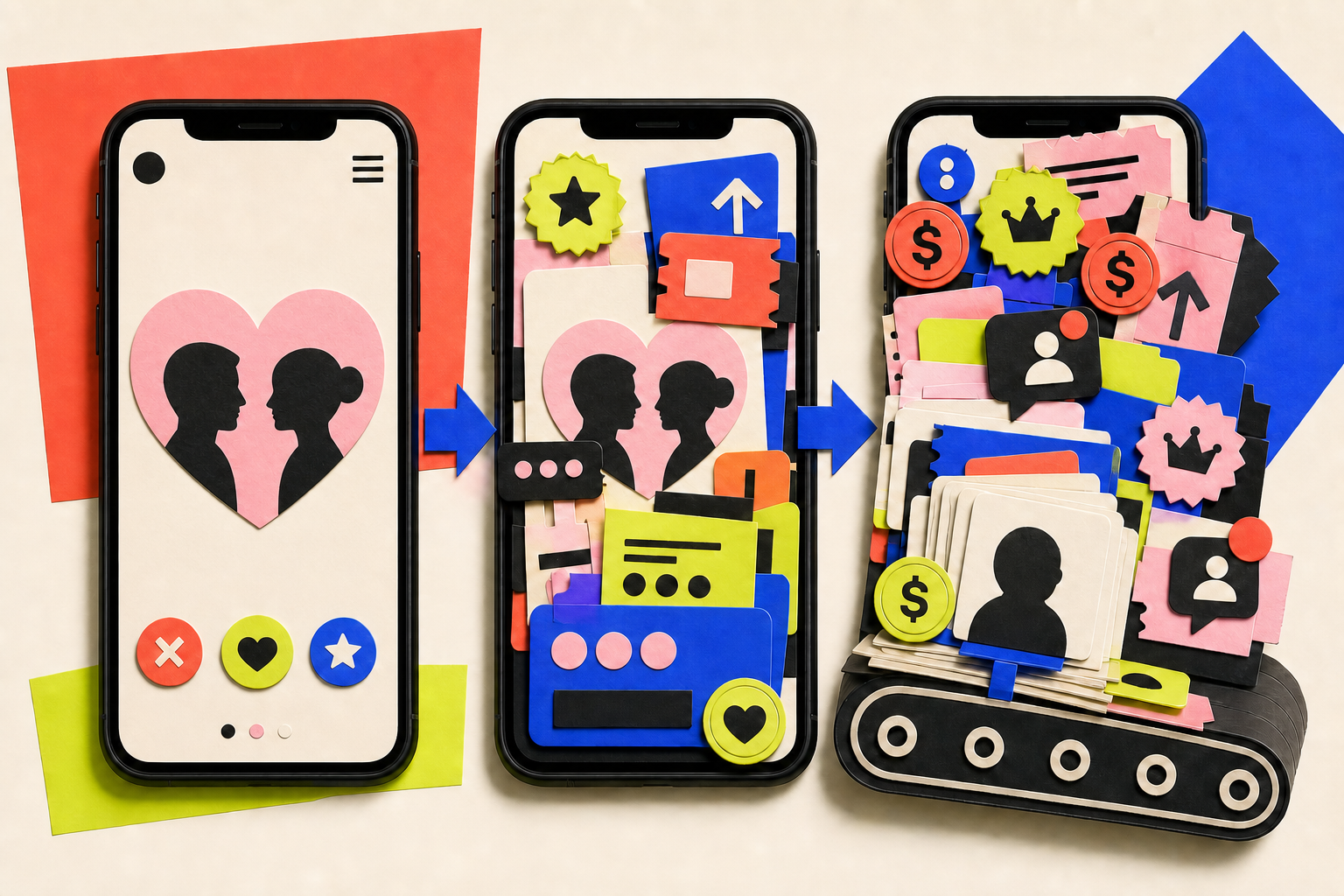
Early dating apps solved a real problem. They helped strangers meet, fall in love and build lasting relationships. Then consolidation, investors and the pressure for endless growth changed the incentives. Independence disappeared. Love became inventory, visibility became a product, and frustration became a conversion funnel.
TODAY'S DATING APPS'
TOXIC CYCLE.
The person using a dating app wants to stop needing it. A business built on subscriptions, paid visibility and recurring attention benefits when they stay. That conflict shaped an industry around browsing, judging and returning. What follows is the toxic cycle behind today’s dating apps, harming romantic relationships across society.
01BROWSEAnother catalogue
→ 02JUDGEA person in seconds
→ 03REJECTWithout reflection
→ 04RETURNThe loop continues
THEN
01GET REJECTEDOr barely seen
→ 02PAY TO STAND OUTBoost, Rose, Spotlight
→ 03BORROW ATTENTIONVisibility expires
→ 04PAY AGAINThe cycle restarts
AND THIS IS WHAT THE CYCLE LEAVES BEHIND:
A study found higher distress, anxiety and depression among swipe-app users. Its authors explicitly call for more research to establish which patterns of use cause harm.
Read the studyDating apps once helped you find love.Now they profit from your frustration and loneliness.
AND SOCIETY
IS LONELIER
THAN EVER.
The human cost
We meet less often, live alone more often and reach life's milestones later. These are not isolated shifts. Together, they describe a society finding it harder to build lasting bonds.
of people across 30 OECD countries lived alone, rising in only one decade.
OECD, 2025 ↗more likely to report loneliness when single than when in a relationship.
OECD, 2025 ↗added to the average age at first marriage across the OECD since 1990.
OECD, 2024 ↗years old: the average age at childbirth rose by 2.4 years from 2000 to 2021.
OECD, 2024 ↗The absence of a suitable partner is the reason most often given for unmet fertility intentions across Europe.
European Journal of Population, 2023 ↗MEANWHILE, A FUTURE
WITH SOMEONE FEELS
FURTHER AWAY.
Building a future with someone is shaped by more than personal choice. Housing costs, economic insecurity, unequal care work, changing preferences and later partnerships can all make a shared life harder to begin.
These pressures sit alongside major demographic shifts. Across the EU, single-adult households without children rose by 19.2% between 2016 and 2025 Eurostat, 2026 . About half of 20- to 29-year-olds still live with their parents OECD, 2025 , while across the OECD, fertility fell from 3.3 children per woman in 1960 to 1.5 in 2022 OECD, 2024 .
Having a partner, getting married and having children are not universal goals, nor should they be. But people who do want a partner, a shared home or a family deserve honest tools built around that intention, not products built to profit from it. Dating apps cannot fix the economic pressures that make a shared future harder. But honest technology, like Lovv, can help people find a committed partner with whom to face life’s challenges as a team rather than alone, instead of turning love into another exhausting marketplace.

Our answer.
lovv
WANTS A LESS
LONELY
SOCIETY.
Too many people are constantly connected and still feel alone. Lovv challenges what dating apps have become and genuinely wants to help people find their life partner through a nonprofit model that puts people before profit. Our reward is helping to build a less lonely, happier society.
lovv
WANTS A
MORE
LOVABLE
WORLD.
Longer lives, greater independence and better technology should make it easier to share a life with someone, not harder.
We want a world where every generation has a fair chance to find real love, build a home in whatever form feels right, and face the complexity of modern life beside the person they choose.

SO WE
BUILT LOVV
DIFFERENTLY.
To help build a less lonely world where more people can find a life partner, we created Lovv as a fully independent nonprofit platform. Free from investors and profit targets, we can reject the toxic mechanics of today’s dating apps and focus on improving society. And because we have careers outside Lovv, we can pursue that mission without trying to get rich. Our reward is helping people find someone to share life with.
01NONPROFIT
02ALWAYS
FREE
FREE
03INDEPENDENT
04NO INVESTOR
CONTROL
CONTROL
OUR ONLY
EXIT STRATEGY
IS YOURS.
READY TO START
YOUR LOVV
STORY?